
Concession: Brief Overview
Governments issue official concessions to create lotteries, toll roads, mines, ferry services, broadcasting licenses and other facilities. A version instigating a system of e-markets combines unique rights for the operators with public service obligations for perhaps 15 years initially.
BACKGROUND: Concessions are Gamechangers
A concession exploits government's leverage to create a facility without taxpayer funding. Pragmatic rather than ideological, they can be dramatically successful.
Take lotteries in the UK as one example. A Conservative legislature passed the 1993 National Lottery Act. Eight international consortia bid for an initial 7-year concession. Camelot, who won, then implemented ahead of schedule. Five billion £1 ($0.75) tickets were bought within 18 months, 90% of adults purchased.
Historically, emerging technologies have been turned into a utility by a concession model. America's 1921 Willis Graham Act gave AT&T an effective monopoly on telephony in return for universal standards across the nation. Once the US was cabled, AT&T's rights were revoked.
A concession typically defines (1) scope of the service (2) rights bestowed on its operators (3) their obligations (4) the award process. Our research applies this structure to e-markets called POEMs, (Public Official E-Markets).
1) Scope of the Markets System
The concession will deliver an integrated system of online markets focused on what working households and small businesses have to sell. POEMs (Public Official E-Markets) should span thousands of sectors embracing labor, finance, services, goods and content.
A random selection of some sectors within POEMs might include ladder rental, loans of $50 for 7 days, laundry services, overnight accommodation, motorbike repairs, acupuncture sessions, neighborhood newsletters, underwriting against failure of transactions in the market, wheelchair rental, snow clearing, all types of journeys, abattoir slots, luggage storage, secure document destruction, sports training, factoring of payments due, short-term parking, prenatal support, roadmending crews, tractor drivers, online coaching. And so, endlessly, on.
Any person or entity in the jurisdiction can enter any sector, on their own terms, with no charges, subject only to legal controls. Users are treated neutrally. FedEx can sell in the local deliveries market on POEMs if they wish, so can an 18-year-old with a bicycle who gets access to the same data and functionality. POEMs just constructs all possibilities for meeting a buyer's needs, ranks them as that buyer wishes, then administers their choice. But the teen-with-a-bike with minimal overheads may be a better fit for some needs. Local buyers will decide.
If this scope seems overly ambitious, or unfathomably weird, it may be worth a brief detour into the history of legal frameworks that unleashed a new technology at previously unthinkable scale. Postage, air traffic control, broadcasting or canals are examples.
2) Rights Bestowed by a Concession
Policymakers crafting a concession must give operators enough advantages to attract the huge investment required to create a new system of markets. Those benefits can support subsidiary aims like government modernization.
The 5 key rights of most value to operators are:

There is nuance behind these rights. Take the "channel for public spending" commitment. It only applies if POEMs is the best option for taxpayers. When a defense ministry commission a submarine, POEMs can't compete with traditional procurement. Only big sellers can provide. But a contract to clean City Hall should go to local workers through POEMs if it can marshal vetted, provenly reliable, locals at an overall cost no more than that charged by an outsourcing company.
3) Public Service Obligations on Operators
The benefits above amount to a significant business opportunity. Politicians need to extract maximum value for their regional economy in return.
A starting list of 5 core obligations to which POEMs' operators must commit:
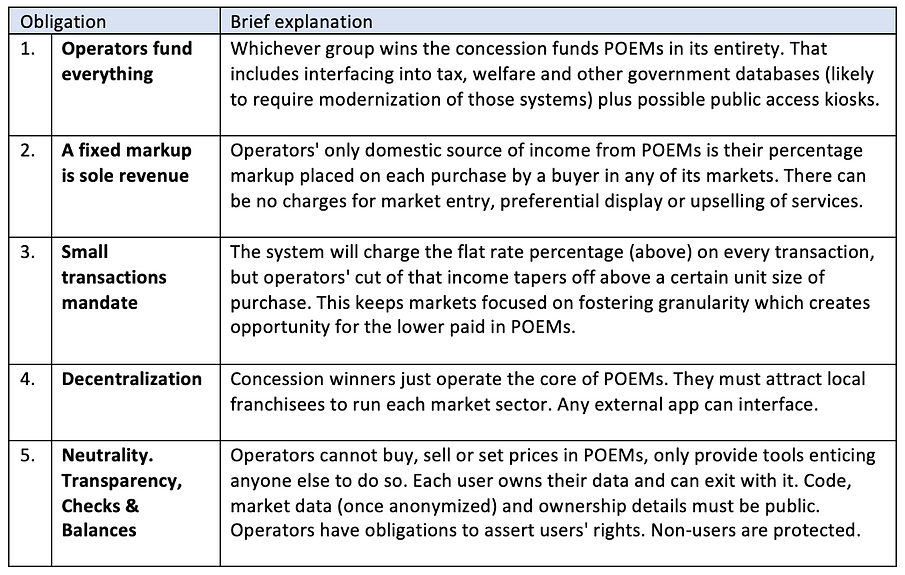
Each of the above obligations is fleshed out in a brief on this site. The key aim: If operators execute successfully, they will get rich from a cut of the activity they enable. But any control over the economy, distortion of markets or extractive practices is hobbled.
4) Awarding the Concession
A typical concession involves a discussion paper and structuring of legislation based on feedback from multiple stakeholders. It can then take 6-9 months for bids to arrive and be assessed. A balance between national and international involvement must be struck.
Who is likely to bid? The core player in each tender is likely to be a large IT systems provider with Cognizant, Accenture, Kyndryl, Capgemini, Tata, IBM and Infosys as examples. A second key member will probably provide the financing in each case.
Each bidding consortia might be told to specify the fixed percentage charge (row 2 above) they would apply to each transaction in POEMs. Once a basic threshold of competency, readiness and bonding was cleared, the winner could simply be whoever commits to the lowest charge on the nation's users for the duration of the concession. Modelling suggests a 2% charge could be an average for well-governed regions.
Once the concession is awarded, government gets out of the way. With a clock ticking on their 15-year period of official benefits, operators have every incentive to drive forward quickly.
5) Post Concession Delivery
Imagine POEMs on day one as a simple bulletin board; classified adverts posted by any user in a directory of its thousands of sectors. But operators are incentivized to convert any sector to an end-to-end exchange.
It is up to POEMs' operators how they launch the platform, but there is an obvious course. At the start the system is broadly akin to a service like Craigslist, anyone can set up an account (using POEMs' interfacing to official documentation if wished) and post an offer to sell or provide something. An email or phone number allows buyers to make contact.
Operators gain no revenue from these dialogues. But POEMs has functionality combing the ads to identify sectors with enough depth to merit replacing the cumbersome bulletin board model with an end-to-end marketplace. That takes in offers and sellers' pricing rules then lists and contracts in a convenient structured way. The fixed percentage markup is deducted from each purchase.
Some sectors will get to critical mass instantly because of the public spending mandate. In childcare as example, classroom assistants, school staff, homecare workers, youth leaders and others will find themselves being booked through POEMs. The system might then ask each person if they want to increase earnings, perhaps by also babysitting for which POEMs already sees demand in its classified adverts. As some workers say yes that sector too becomes an end-to-end market. This deepening activity could then justify marketization of home tutors, and so on.
Likewise, public buying of maintenance workers, bus drivers, security guards and cleaning crews should quickly spawn comprehensive markets for hour-by-hour labor in those huge sectors, likely to quickly spill into related specialisms like warehouse staffing. Everyone can build a track record of reliable trading and leverage it as they wish to attract more pay, foster stability or attract investment in upskilling. POEMs must of course comply with general economic regulation, enforcing controls on use of temporary staff for example.